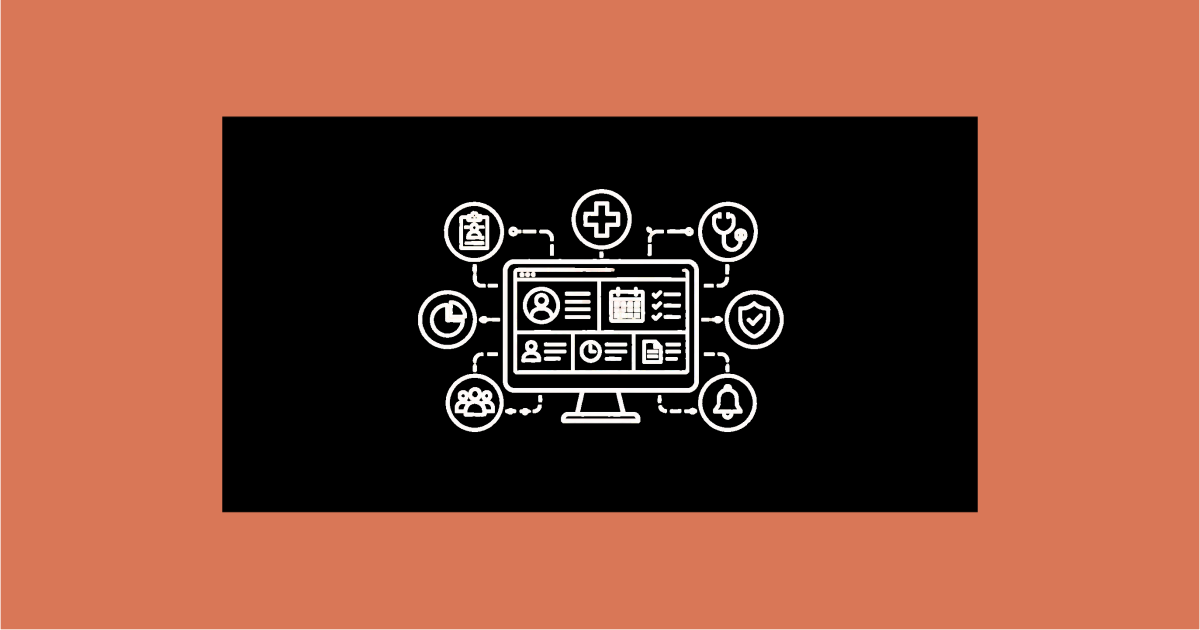
"Hospital management system" sounds like something a 200-bed hospital buys. For a small clinic the useful version is much narrower: software for the four things a clinic does every day, appointments, records, prescriptions and billing. This guide is about that narrower version, and about not overbuying.
For the general picture, see our guide to hospital and clinic management systems.
What a small clinic actually needs
- Patient records that are findable by name or phone, holding history, allergies, notes per visit and uploaded reports.
- Appointments with doctor-wise slots that match real timings, plus walk-ins and reminders.
- Digital prescriptions on the clinic’s letterhead, printed or sent on WhatsApp, with templates for the common ones.
- GST billing in the clinic’s branding, with payment tracking and a collection report.
That is the whole list for most single-doctor and small multi-doctor clinics. Everything beyond it, wards, an in-house lab module, pharmacy stock, TPA claims, is hospital scope, and a clinic that pays for it spends its first month navigating around screens it will never use.
What digitising each part changes
- Records: the history stops depending on a file being in the right cupboard. Two people can use a record at once. Nothing is lost to misfiling.
- Appointments: reception cannot double-book a slot that does not exist. Patients wait closer to their time. Reminders cut no-shows.
- Prescriptions: the pharmacy can read them. The patient still has them a week later because they are on WhatsApp. Repeat prescriptions are consistent.
- Billing: month-end reconciles because every payment is against an invoice. GST is correct at filing time.
Where outside lab reports fit
Small clinics send patients to an external laboratory. A clinic system does not run that lab, there is no sample tracking or result verification, but it should let the clinic or the patient upload the finished report PDF to the record, so the result is with the history at the next visit. If a clinic runs its own lab at volume, that is a separate lab system’s job, alongside the clinic software.
Cost, honestly
Clinic software is priced by doctor count, billed monthly, plus 18% GST. A single doctor is roughly ₹800–₹1,500 a month; a small clinic of up to about eight doctors, roughly ₹3,000–₹6,000. As a concrete reference, CareZenix is ₹999 for one doctor and ₹4,999 for up to eight, plus GST, with setup and support included and no per-patient charge. SMS and WhatsApp delivery is billed at actual usage on top. Ask every vendor for the all-in first-year figure so onboarding and training fees do not surprise you.
Common mistakes when a small clinic buys
- Buying hospital scope because the demo looked impressive.
- Not checking the prescription on the clinic’s own letterhead and printer.
- Assuming a free trial, several good vendors do not offer one, and a guided demo on your own setup tells you more anyway.
- Skipping the export question, know how you get your data out before you sign.
- Whose brand? Confirm patients see the clinic’s name on documents, not the vendor’s.
Will the staff actually use it?
This is the question that decides the purchase, and it is mostly about the first fortnight. A small clinic usually has one or two reception staff and one to three doctors, and if any of them quietly go back to paper, the records stop being complete and the system is worse than useless, you are now maintaining two half-records. What makes adoption stick: the account is configured before training starts, so nobody learns workarounds; training is on the real tasks each person does, not a feature tour; and there is a person on the phone or WhatsApp for the questions that come in week three. If a vendor cannot describe how those first two weeks go, treat that as a warning.
How CareZenix fits a small clinic
CareZenix is built for exactly this: an outpatient clinic system with patient records, appointments, branded digital prescriptions, GST billing, an embeddable booking widget and WhatsApp reminders. The account is set up for you, clinic, doctors, timings, fees, before you log in. It deliberately has no inpatient, laboratory or pharmacy modules, so a small clinic’s staff can learn it quickly. Full scope on the features page.
The takeaway
A small clinic does not need a hospital system. It needs clean records, a schedule that holds, legible prescriptions and correct GST billing, in one place, carrying its own name. Buy that, check the prescription and the invoice yourself, confirm you can leave with your data, and skip everything built for departments you do not have.
Related reading
Frequently Asked Questions
Insights and details about this topic.
A hospital management system is software that helps healthcare providers manage patient records, appointments, billing, and hospital operations digitally.
Yes. Modern hospital management systems are designed for both small clinics and large hospitals. They help clinics manage patient data and appointments efficiently.
Hospital software helps doctors access patient medical history, track consultations, manage appointments, and review diagnostic reports easily.
Yes. Most modern healthcare platforms include secure data storage and access controls to protect sensitive patient information.