"Healthcare ERP" and "clinic management software" get used as if they mean the same thing. They do not. An ERP is the back-office backbone of a large healthcare organisation, finance, procurement, inventory, HR, payroll, tied together in one system. This guide explains what a healthcare ERP is, what it is for, and why most clinics do not need one.
What an ERP actually covers
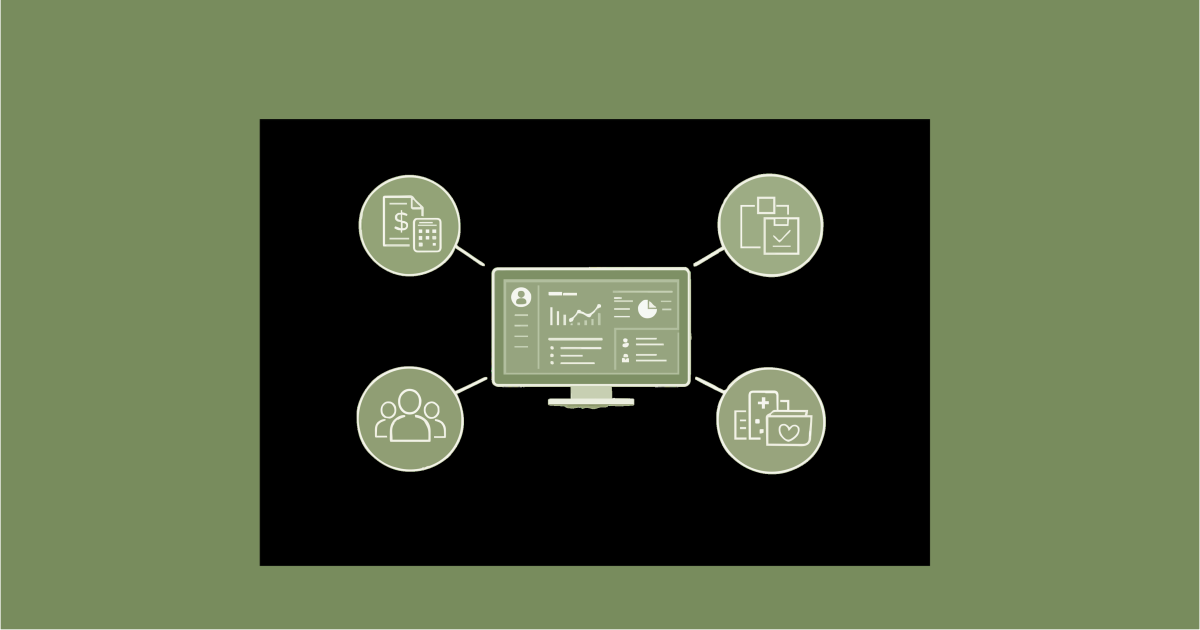
Enterprise Resource Planning software integrates the functions that keep an organisation running as a business, not the ones that treat patients:
- Finance and accounting: general ledger, accounts payable and receivable, budgeting, statutory reporting.
- Procurement and inventory: purchase orders, vendor management, stock of consumables, medicines and equipment across stores and departments.
- Human resources and payroll: staff records, rostering, attendance, salary processing, statutory compliance.
- Asset management: equipment registers, maintenance schedules, depreciation.
- Reporting across all of it: so the finance head sees procurement, HR sees overtime cost, and management sees the whole picture.
A clinical system, HMS, EMR, clinic software, sits alongside an ERP and feeds it, mainly revenue data. The ERP is not where a doctor works.
Who needs one
ERPs earn their cost in organisations with real back-office complexity: multi-hospital groups, large teaching hospitals, chains with central procurement and hundreds of staff on payroll. There, the alternative, separate finance, HR, inventory and payroll systems that do not talk to each other, genuinely costs money in duplicated work and blind spots.
Who does not
A single clinic, or a small group, does not have that complexity. Its finances fit in standard accounting software (Tally, Zoho Books, similar). Its inventory is a short list. Its payroll is a handful of people. Bolting an ERP onto a five-doctor clinic means a long, expensive implementation to solve problems the clinic does not have, and staff maintaining modules nobody looks at. The clinic system plus ordinary accounting software is the right stack at that size.
If you are a group deciding
- Name the pain. Which back-office process is actually broken, procurement, payroll, inter-branch accounting? If you cannot name one, you are not ready for an ERP.
- Healthcare-aware or generic? Generic ERPs (SAP, Oracle, Microsoft Dynamics) are powerful but need heavy customisation for healthcare. Healthcare-specific ERPs come with the workflows but a smaller ecosystem.
- Integration with the clinical system. The ERP has to take revenue and usage data from your HMS/EMR cleanly, or you have just created a new manual reconciliation.
- Implementation reality. Healthcare ERP projects run in quarters, not weeks, and need internal project ownership. Budget for that, not just the licence.
- Phase it. Finance first, then procurement and inventory, then HR and payroll. A big-bang cutover across all modules is how these projects fail.
The cost of getting it wrong
An ERP bought for a clinic that does not need one is not a neutral mistake. The licence is a small part of it; the real cost is the implementation, months of consultant time, staff pulled off their jobs to define processes, data migrated from systems that worked fine, followed by ongoing maintenance of modules nobody opens. Clinics that go down this road often end up running the ERP for finance only and keeping spreadsheets for everything else, which is a worse position than they started in. The reverse mistake, a genuine hospital group trying to run central procurement and payroll for six sites out of disconnected tools, is also expensive, just less visibly. The skill is matching the tool to the actual scale.
Where CareZenix fits
CareZenix is not an ERP and does not try to be. It is an outpatient clinic system: appointments, records, prescriptions, GST billing, reminders. For a clinic or small group, that plus standard accounting software is the whole stack you need. If you grow into a multi-hospital group with central procurement and payroll, an ERP becomes a separate, later decision, and CareZenix (or whatever clinical system you run) would feed revenue data into it rather than be replaced by it.
The takeaway
An ERP manages the business of a large healthcare organisation, finance, procurement, inventory, HR. It is the right tool for hospital groups with genuine back-office complexity and the wrong tool for a clinic, which is better served by clinical software plus ordinary accounting. Do not let a vendor sell you an ERP for a problem you can name in one sentence.
Related reading
Frequently Asked Questions
Insights and details about this topic.
It is an integrated software that manages operations like finance, inventory, HR, and patient data in healthcare organizations.
It improves efficiency, reduces errors, and integrates multiple processes into one system.
Yes, it integrates with PMS, HMS, CRM, and EMR systems.
Yes, scalable ERP solutions are available for clinics of all sizes.
Better coordination, improved efficiency, and enhanced decision-making.